


|
Written by Ametris |
Conventional cardiovascular trial endpoints — mortality, major adverse cardiac events, hospitalizations — are definitive, but they tell you little about what patients actually experience day to day. The distance they can walk, how many stairs they can climb, and the daily activities that leave them breathless matter to patients, yet these meaningful aspects of health are typically reduced to a single self-reported number, drawn from a week of imperfect recall compressed into a questionnaire
This gap between what we measure and what matters to patients has prompted a rethinking of endpoint strategy.  A recent Digital Health Monthly webinar brought together experts from industry, academia, and clinical practice to explore how continuous, objective wearable data can complement traditional cardiac endpoints, surfacing symptom burden and treatment benefit that conventional methods may never detect.
How Continuous Monitoring Differs with Patient Self-Reporting
Research presented during the webinar showed that when individuals with coronary artery disease self-reported their moderate-to-vigorous physical activity (MVPA), the association with reduced mortality appeared modest. But when the same population wore accelerometer devices for seven days, the risk reduction was substantially larger—a 50% decrease in all-cause mortality for those achieving 150 minutes of weekly moderate-to-vigorous activity, climbing to 70% at higher thresholds. Patients were systematically underestimating their activity, driven by recall bias.
For trial sponsors, the implication is direct: relying on patient-reported physical activity as a secondary endpoint may systematically underestimate treatment benefit. The solution is to augment traditional endpoints with data that captures behavior as it unfolds.
Establishing Analytical Validation Prior to Deployment
Before adopting wearables in trials, validity must be established: How accurate are they? What are their limitations?
In collaboration with Ametris through DEAR grant initiative, researchers at the University of Canberra validated step count algorithms in 20 heart failure patients who performed graded activities from sedentary (television) to dynamic (sweeping, marching, overground walking) while wearing wrist accelerometers. Ground truth was derived from video analysis coded by trained observers.
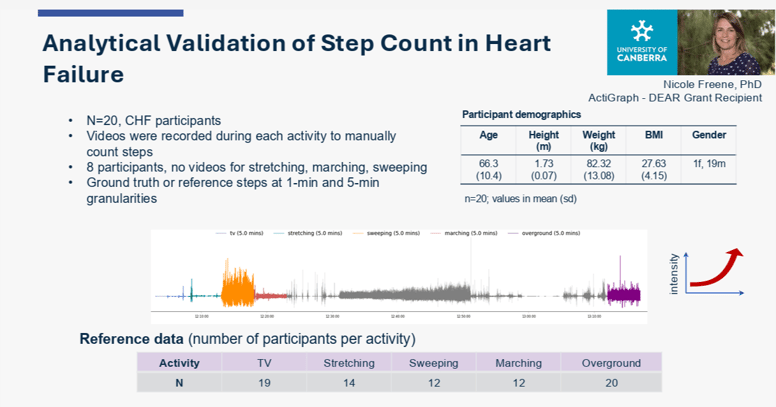
Results revealed important nuances. Overground walking showed a mean absolute error under nine steps—acceptable for clinical use. Static activities like television watching were nearly perfect. But dynamic movements, particularly sweeping and marching, showed consistent overestimation of 50–60 steps per minute. The wrist undergoes rapid, repetitive non-gait motion during these tasks, confounding the signal.
The implication is critical: wearable performance is activity-specific. For sponsors, this means validation work must precede deployment. Testing multiple algorithms against ground truth under real-world conditions is essential before trial launch.
From Validation to Clinical Application
Once validated in a target population, wearable data moves into the trial setting. A UK Biobank cohort with accelerometer data on 2,500 heart failure patients provides precedent. After adjusting for age, BMI, and gender, heart failure patients showed 70 fewer minutes per week of moderate-to-vigorous activity compared to controls—a quantifiable deficit that complements traditional clinic assessments.
 Wearable data gains power when paired with complementary modalities. Heart rate derived from photoplethysmography (PPG) data from the same device can contextualize activity intensity, answering clinically relevant questions: Does the patient achieve the same steps with less cardiovascular strain after treatment? Are they recovering faster? These questions cannot be answered by step count alone.
The same rigor applies to cardiac monitoring. A cardio-oncology team validated single-lead and six-lead smartphone ECG devices against twelve-lead ECG in patients on cancer therapies that prolong QT interval. The smartphone devices matched accuracy while dramatically reducing patient burden and cost. The lesson: analytical validation in controlled conditions must precede real-world deployment.
What Clinicians and Patients Need
Two requirements emerge repeatedly: actionability and usability. Clinicians are overwhelmed with data but starved for information they can act on. A step count without context is noise.
Researchers developed disease-specific step cadence thresholds linked to cardiorespiratory intensity in patients with coronary disease. For moderate-intensity activity, the target was 106 steps per minute (relative intensity). For vigorous, 112–135 steps per minute. These thresholds derived from oxygen uptake measurements during treadmill protocols in 86 patients.
With these thresholds, clinicians and patients can interpret daily cadence: is this patient hitting targets, or do they need intervention? The data becomes actionable.
Similarly, patients expressed that wearables must be intuitive. Devices requiring daily charging, frequent setup, or complex interpretation see adoption drop. Smartphone ECG devices in validation studies were universally well-liked because they removed barriers—no clinic travel, no wait, results within hours.
Practical Next Steps for Sponsors
Before wearables enter your trial:
- Conduct validation in your target population against accepted ground truth methods under real-world conditions.
- Define your clinical question narrowly. Wearables excel at capturing continuous behavior in specific domains; choose the measure addressing your mechanism of action.
- Establish disease-specific thresholds or interpretive frameworks. Raw data becomes information when clinically contextualized.
- Plan for multi-modal integration. Heart rate, activity, sleep, and PPG measures work together to construct richer pictures of treatment effect.
The highest-performing trials of the future will combine traditional efficacy endpoints with continuous, validated, patient-centered measures of function. Wearables are not replacing clinical endpoints; they are expanding the lens through which we evaluate treatment benefit and opening new pathways to demonstrate meaningful improvement.
Reach out to the Ametris team to discuss fit-for-purpose validation for your program. Schedule a meeting for your study’s needs.
Related Resources
-
New Blog Article: Monitoring Atrial Fibrillation in Clinical Research: The Case for Continuous Wearable Assessment
-
Digital Endpoint Guide: Heart Failure Indication Guide