


|
Written by Rakesh Pilkar, PhD |
Insights from the Ametris Digital Data Summit (ADDS) 2026 Pre-Conference Workshop
At the annual ADDS 2026 conference in Atlanta earlier this year, Ametris held a pre-conference workshop on Huntington’s Disease (HD), bringing together a diverse group of stakeholders including clinical experts, regulators, digital health technology (DHT) developers, and academic researchers. The session served as a timely forum to reflect on the current state of HD clinical development and explore how DHTs can reshape the future of outcome measurement and HD clinical trials.
Current Challenges
Huntington’s disease presents a uniquely complex challenge for clinical trials. As a progressive, autosomal dominant neurodegenerative disorder, it affects both motor and non-motor domains in ways that are often subtle during early stages. While traditional clinical outcome assessments such as the Unified Huntington’s Disease Rating Scale (UHDRS) have long served as the standard, workshop discussions highlighted several critical limitations in the current clinical development landscape, including disease heterogeneity and challenges with patient stratification, subjectivity and susceptibility to placebo effects in clinician-rated measures, limited sensitivity to early-stage changes, lack of alignment on key concepts of interest and their clinical meaningfulness, and insufficient capture of real-world patient experience alongside usability considerations for digital health technologies.
A consistent theme emerged that existing tools are not adequately equipped to detect the nuanced, real-world manifestations of HD, particularly as the field increasingly shifts toward earlier intervention.
Regulatory Perspective: Defining the Right Problem First
 Michelle Campbell, PhD (FDA) emphasized a foundational principle in deploying DHTs: start with the right question. Before introducing technology into trials, sponsors must clearly define what aspect of the disease is being measured, disease stage, and the expected treatment effect and usability of DHTs in the given population. Another key insight was the need for stronger collaboration between sponsors and technology developers. Regulatory submissions often require detailed information on algorithms and data processing—information that developers possess, but sponsors may not. Bridging this gap through early and transparent partnerships is critical for success. She also acknowledged that methodology for establishing clinical meaningfulness might look differently for outcome measures for early stage of the disease from conventional ones.
Rethinking Disease Staging: HD Stages and the Role of HD-ISS in Clinical Trials
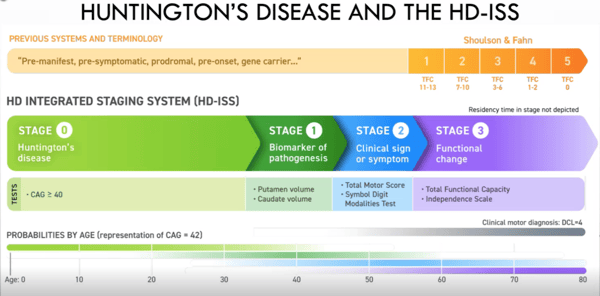
 Swati Sathe, MD (CHDI Foundation) provided an overview of evolving HD staging frameworks. Historically, HD diagnosis relied heavily on clinician confidence, introducing subjectivity and limiting biological precision. The introduction of the HD Integrated Staging System (HD-ISS) represents a major advancement. By incorporating genetic, biomarker, and clinical data, HD-ISS offers a more standardized and biologically grounded framework. However, early-stage populations are highly heterogeneous, HD ISS Stage 2, a common target for trials, but still lack homogeneity and optimal timing for intervention remains uncertain. This uncertainty creates an opportunity for DHTs. More sensitive and continuous measurements could help better define early disease and stratify patients, enabling more targeted and efficient trials.
Roundtable Discussion: Current Measurement Tools and What the Measures Should Look Like
During the roundtable discussion on the future of outcome measures in Huntington’s disease (HD), participants highlighted key gaps in current approaches and articulated a vision for more robust and meaningful assessments. Existing measures were criticized for being largely subjective, episodic, and insufficiently sensitive to detect early disease changes, with limited patient-centricity and inadequate capture of important domains such as sleep and cognition. In contrast, the ideal future state emphasizes the adoption of objective and continuous measurement approaches with high sensitivity to early progression, alignment with HD-ISS frameworks, and the development of patient-centric, clinically meaningful endpoints. Collectively, these advances aim to enable greater precision and a more holistic characterization of disease burden and progression in HD.
Digital Health Technologies in HD: Unlocking Continuous, Real-World Insights

 Jamie Adams, MD (University of Rochester) and Lori Quinn, EdD (Columbia University) highlighted the growing evidence base for DHTs in HD. It was emphasized that supervised, semi-supervised, and passive data collection approaches allow for flexible study designs, including fully decentralized trials like MEND-HD.
Key Opportunities for Digital Measurement in HD were presented with data. Gait metrics emerged as one of the most promising digital biomarkers. Data showed the DHTs were able to demonstrate increased step-to-step variability and irregularity, reduced gait velocity in pre-manifest HD, and detectable abnormalities even with low chorea.
Interestingly, it was shown that while overall activity levels may remain unchanged, movement quality deteriorates, making gait variability a sensitive marker of progression. Novel wearable-derived measures, such as truncal chorea demonstrated sensitivity to treatment effects in studies like CONNECT-HD. DHTs were able to differentiate between prodromal and manifest HD through activity patterns and sleep disturbances (e.g., increased nocturnal movement).
Overall, potential measures of interest that can offer valuable insights into functional decline in HD included step regularity, variability, and irregular movements in gait, chorea (upper extremity), sedentary time and total daily physical activity, time in bed, and sleep fragmentation.
Physiological measures, including heart rate variability and respiration during sleep, may further inform disease progression and overall health status.
Industry Perspective: Practical Challenges in Passive Monitoring
 Jonas Dorn, PhD (Roche) provided an industry lens on deploying DHTs in HD trials. It was shown that clinician-reported outcomes may introduce the placebo effect in the context of an interventional trial as opposed to natural history studies (possibly due to the rater bias), whereas objective, continuous data from DHTs can reduce such placebo effect. It was demonstrated that high-frequency wearable data comes with different time scales (seconds, minutes, days, months and years) and different time scales answer different questions. Therefore, the selection of appropriate time scales that are meaningful to HD is an important factor to consider. Independent of the disease itself, how the lifestyle and environmental changes can impact the digital endpoints were discussed. It was also proposed that the strategies should be in place to support adherence, avoid missing data and ensure high quality data capture.
Patient Perspectives: Are Participants with HD Willing to Adopt DHTs?
 Matthew Roche, PhD (CHDI Foundation) presented findings from a DHT preference survey among individuals with Huntington’s disease (HD) or those at risk, highlighting high ownership of smartphones, wearables, and fitness trackers, with majority of participants reporting high-comfort levels and a strong willingness to use smartwatches and fitness devices throughout the full duration of clinical trials. However, this willingness may not always translate into sustained adherence, underscoring the importance of continuous adherence monitoring, and effective engagement strategies to mitigate reduced compliance during trials.
Roundtable Discussion: Top Concepts of Interest, Datasets and Regulatory Considerations
Gait, chorea, movement (pronation/supination, flexion/extension, finger tapping) and sleep were identified as key concepts. The open discussion touched various topics around these concepts in terms of evidence generation, patient meaningfulness, potential regulatory pathways and endpoint positioning. A problem of “plenty” in terms of digital measures was discussed and the need for consolidation and validation was highlighted.
Despite the richness of digital data, a critical question remains: which metrics truly matter to patients? For example, while step irregularity may be highly sensitive, its clinical and patient relevance must be established. Workshop discussions emphasized that not all meaningful endpoints originate from patient-reported experiences. It was also discussed that the longitudinal datasets, which are currently lacking in HD, are key to linking digital signals with clinical outcomes and data-driven approaches are essential for identifying sensitive markers. To address this critical need, several approaches such as central-IRB driven, externally funded data collection efforts were discussed.
Key Takeaways and the Road Ahead
The workshop underscored a pivotal shift in HD clinical development: while traditional outcome measures remain insufficient to capture early, subtle, and real-world disease manifestations, DHTs offer a transformative path forward through objective, continuous, and patient-centric measurement. Realizing this potential, however, requires first defining clinically meaningful questions, aligning endpoints with frameworks such as the HD-ISS, strengthening collaboration between sponsors and technology developers for evidence generation and regulatory readiness. Emerging evidence highlights gait, movement, sleep, and physiological signals as promising concepts of interest, yet translating these data into regulatory-grade, patient-relevant endpoints remains a key challenge—one that depends on robust longitudinal datasets, thoughtful endpoint selection, and strategies to ensure adherence and data quality. While these challenges remain, growing evidence, cross-sector collaborations, and increasing patient willingness to engage with these technologies signal strong momentum. Collectively, these advances position the field to move toward more precise, efficient, and impactful clinical trials—bringing the promise of earlier intervention and better outcomes for individuals with HD closer to reality.
To learn more about Ametris DHT solutions for Huntington's Disease research, contact us and set up a meeting with a member of our team!
Related resources: