

|
Written by Matthew Patterson, PhD |
Sleep disorders can negatively impact nearly every aspect of daily life and are a growing focus of clinical research and development. Insomnia, a condition characterized by persistent difficulty falling or staying asleep, is the most common sleep disorder, with 12% of the US population reporting a chronic insomnia diagnosis (American Academy of Sleep Medicine, 2024) and many millions more experiencing symptoms on an occasional basis (Ford et al., 2015). Less common sleep disorders such as narcolepsy and idiopathic hypersomnia (IH), which both involve significant disruptions to the sleep-wake cycle and severe, unmanageable excessive daytime sleepiness (EDS), are typically lifelong neurological conditions that impact a person’s ability to function at school, work, home, and in social situations (FDA Project Sleep, 2022). Additionally, the consequences of long-term impaired sleep can extend to health risks such as obesity, diabetes, hypertension, and stroke (Shah et al., 2025).
Conventional Sleep Assessment
Methods and Limitations
There are three types of assessments that clinical researchers most commonly use, either individually or in combination, to measure sleep behavior: polysomnography (PSG), patient sleep diaries, and actigraphy monitoring.
-
-
-
Polysomnography (PSG) is considered the gold-standard method for objective sleep measurement. PSG, which is often called a sleep study, requires the patient to sleep overnight in a clinic while a battery of sensors and medical equipment continuously measure parameters such as brain activity, eye movement, respiration, muscle tone, and oxygen saturation. Though PSG offers a high level of scientific accuracy, this assessment is very costly and difficult to scale across large studies (Natsky et al, 2022). Moreover, sleep studies are invasive and burdensome to patients, and their episodic nature and laboratory setting do not accurately reflect the real-world sleep environment.
- Sleep Diaries are patient-reported outcome tools (PROs) that are used to assess sleep behaviors such as sleep quality and awakenings over time. The Epworth Sleepiness Scale (ESS) is a PRO commonly used in sleep disorder research, with patients self-reporting their levels of sleepiness during different activities throughout the day. While PROs reflect the patient voice and enable cost-efficient, long-term assessment in the natural setting, they are subjective evaluations that are prone to recall bias and high interpatient variability, which can lead to over- or under-estimation of sleep duration and awakenings compared to objective tools such as PSG or actigraphy (Zhang et al, 2007)
- Actigraphy is a tool that has been used to objectively assess sleep/wake behavior in clinical research and care for the past 40 years (Patterson et al, 2023). These wearable devices use an accelerometer sensor to capture 24-hour motion data in the patient’s natural environment, with each epoch of data classified as either sleep or wake based on wrist acceleration. In a randomized control trial evaluating a new therapy for chronic insomnia, patients were assessed with PSG, sleep diaries, and home-based actigraphy. Improvements in insomnia symptoms supported by both actigraphy data and subjective patient reports but were not detected by PSG (Walsh et al, 2021). Actigraphy monitoring enables continuous, objective, and ecologically valid data collection and is sensitive enough to detect subtle changes in sleep behavior over time.
-
-
Daytime Sleepiness: A Unique Measurement
Challenge in Sleep Disorders
While sleep disorders like insomnia, narcolepsy, and IH each have unique pathologies and symptoms, patients with these conditions are all likely to experience Excessive Daytime Sleepiness (EDS), an inability to maintain alertness during primary waking hours that can result in unintended lapses into sleep (Murray, 2016). EDS arises from complex, neurobiological disruptions of the brain’s sleep-wake regulatory systems and can be characterized by the frequency and duration of daytime naps, along with the percentage of the awake period spent napping. This excessive daytime sleepiness and napping can be debilitating, causing significant impact to daily functioning and safety for many patients.
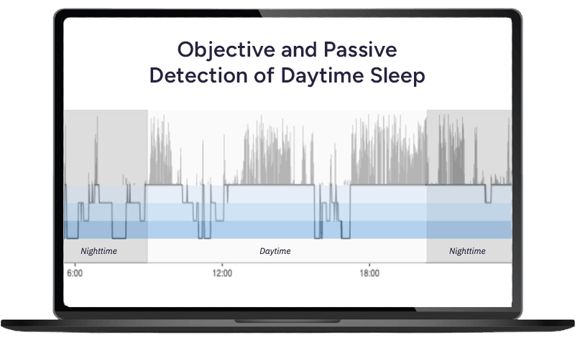
Measuring daytime sleep can provide valuable insights into sleep disorder severity and treatment efficacy. However, the nature of this behavior can make it challenging to assess. The gold-standard PSG is not a viable option since EDS and resulting sleep periods occur during waking hours, and patient sleep diaries can be burdensome and susceptible to recall bias and high variability between patients (Lawrence et al, 2018). In contrast, objective sensor-based assessments like actigraphy collect continuous, 24-hour data, enabling the identification of sleep periods throughout the day as well as the night. More recently, next generation wearables capable of collecting multimodal sensor data, such as the ActiGraph LEAP, can further increase the accuracy and specificity of wearable-enabled sleep assessment and enable the robust detection of sleep periods during daytime hours. The amount of time spent sleeping during the day is an important aspect of health in patients with sleep disorders that has been difficult to assess previously.
Selected Digital Endpoints in Sleep Disorder Research
Ametris Solutions for Daytime Sleepiness
in Sleep Disorder Research
To address the measurement gaps in excessive daytime sleepiness (EDS), Ametris has developed a digital endpoint approach for sleep disorder research built on continuous, real-world digital data. At the center of this solution is the ActiGraph LEAP, a multi-sensor, wrist-worn device that captures raw acceleration and vital signs data across 24-hours in the patient’s natural settings.
The acceleration signals are segmented into short epochs (typically 30–60 seconds) and processed using validated sleep–wake classification algorithms (Patterson et al, 2023) including state of the art deep learning-based algorithm (Constantin et al, 2026). This analytic framework enables consistent classification of sleep and wake across both nocturnal and daytime intervals.
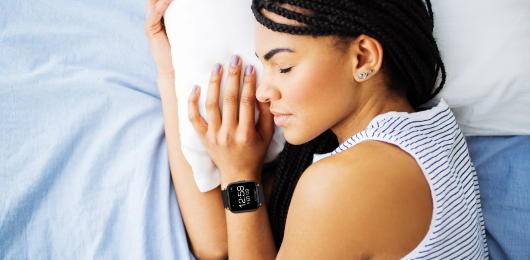
Building on this foundation, Ametris has developed daytime sleep digital measures designed specifically for sleep disorder research. The digital measures quantify naps and extended sleep bouts occurring during daytime. Outputs may include daytime total sleep time, nap frequency and duration, and patterns of fragmented daytime dozing, metrics that directly align with the clinical characterization of EDS in narcolepsy and idiopathic hypersomnia patient (FDA Project Sleep, 2022).
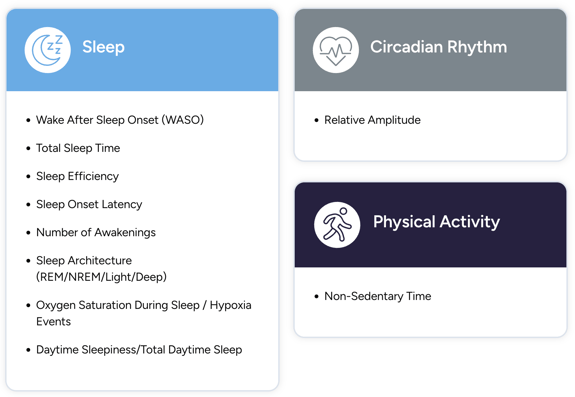
In parallel, the Ametris platform derives standard nocturnal digital endpoints, including total sleep time (TST), sleep efficiency, sleep architecture, and wake after sleep onset (WASO), enabling comprehensive 24-hour sleep/wake profiling from a single wearable-enabled data stream (Patterson et al, 2023). Continuous, passive data capture captured by the Ametris technology solution minimizes participant burden and reduces reliance on diary-based event reporting to support scalable deployment across multi-site clinical studies.
To learn more about Ametris DHT solutions for sleep disorder research, contact us and set up a meeting with a member of our team!
Related resources: